Francis Schmaeling Jr.
Secondary ELAR & ESL Candidate | Dallas, TX
Why I Would Be an Asset
RESEARCH-BASED
Explicit modeling, checks for understanding, and structured practice.
CALM CULTURE
Warm-demanding expectations and predictable routines.
LITERACY-FOCUSED
Strong modeling for analysis, writing, and close reading.
EB SUPPORT
Vocabulary, visuals, frames, and structured discussion.
COACHABLE
Responsive to feedback; reflective practitioner.
COMMITTED
Long-term focus on students, families, and campus growth.
Dallas ISD Alternative Certification Secondary English and Language Arts candidate with 2 years of professional experience in the cybersecurity industry transitioning into a career in education. Passionate about creating an engaging environment with intentional, effective instruction with differentiation to promote student mastery for all learners.
- Admitted to a selective, district-funded Alternative Certification Program with full tuition covered by Dallas ISD.
- Completed over 50+ hours of targeted classroom observations, gaining practical experience inside classrooms and observing inclusive, differentiated practices that meet the needs of diverse learners.
- Applied research-based instructional and classroom-management strategies in supervised, real-world settings.
- Exams Passed: TExES 331 – ELAR 7-12 | TExES 154 – ESL Supplemental.
- Launched and led a cybersecurity start-up with a focus on secure video conferencing and endpoint protection for consumers and small businesses.
- Set project goals and created calendar-based timelines to ensure consistent progress and completion of strategic priorities within planned timeframes.
- Delivered virtual presentations up to eight times per week, presenting to groups of up to 60 participants demonstrating strong public speaking and instructional communication.
- Design and teach weekly two-hour long English lessons for a class of 14 adult learners, focusing on speaking, listening, grammar, and real-life communication.
- Differentiate instruction to meet the varying needs of English language learners from diverse cultural and ethnic backgrounds.
- Create a welcoming and inclusive classroom environment that encourages student participation and growth.
- GPA: 3.46 / 4.00 | Academic Honors: 4.0 Honor Roll (Spring 2023); Dean’s List (Fall 2021).
- Relevant Coursework: Philosophy of Language (Capstone), Introduction to Logic, Technical Writing, and Science Technology and Society (STS).
- Recipient of Covid-19 Student Success Award for academic resilience and adaptability.
- Developed strong verbal communication skills through coursework in logic, ethics, and philosophy of language.
- Led the submission of the college’s entry to the EPA Campus RainWorks Challenge.
- Coordinated volunteer events and fundraisers to support heart disease research.
- ACT: 30/36 SAT: 1380/1600
Skills: Microsoft Office, Zoom, Canva, Google Classroom, Pearson English Connect, Lesson Planning.
Interests: Hiking, Creative Writing, Teaching, Dallas Sports Teams, Golf, Philosophy.
Teaching Philosophy
My philosophy focuses on creating an engaging, inclusive environment where every student feels empowered to learn. I believe in differentiation to meet diverse needs and fostering real-world communication skills.
My Philosophy in Action
Sample Lesson Plan
This section showcases a sample ELAR lesson designed to improve reading comprehension and analytical skills.
Lesson Demonstration (Video)
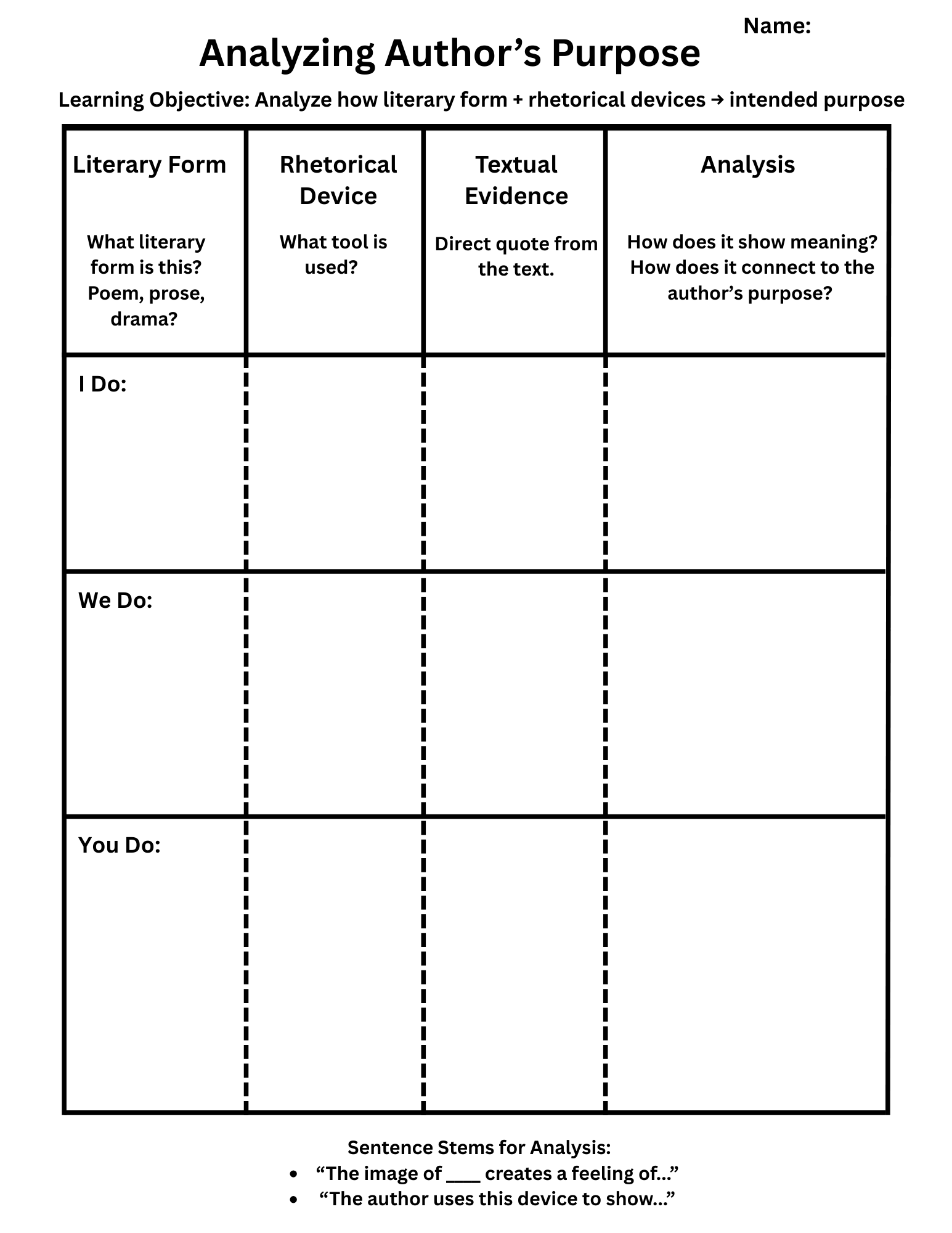
Lesson Resource: Graphic Organizer
Teaching Strategies for ELAR / ESL
Here are three core strategies I implement to ensure student success in my ELAR and ESL classrooms.
Strategy 1: Gradual Release of Responsibility
One key strategy I took away from my training is using the Zone of Proximal Development in combination with the Gradual Release of Responsibility model to move students from supported learning to independent mastery. In a lesson on analyzing an author's purpose, I would first model the skill through a think-aloud, demonstrating how to identify the author’s purpose with textual evidence (“I Do”). Then, during guided practice, students would work with me to analyze a second passage, with graphic organizers to scaffold (“We Do”). Finally, students would independently analyze a new text and write a short response using textual evidence (“You Do”). This approach ensures students are challenged at the right level so as to not overwhelm them while gradually building their confidence and skills required for long-term success.
Strategy 2: Think-Pair-Share
Collaborative Learning for Speaking and Listening
The classroom atmosphere is a key factor in student achievement. I would create a warm, academically-oriented environment using Think-Pair-Share to encourage speaking, listening, and student collaboration. Students would respond to a question independently during the “Think” phase, allowing them time to organize their thoughts without pressure. Next, they discuss ideas with a peer during the “Pair” phase, building confidence and supporting language development for ELLs. Finally, students share their responses with the whole class during the “Share” phase. This strategy ensures participation, reduces anxiety for students, and practices one expressive and one receptive domain of language.
Strategy 3: Culturally Responsive Instruction
Creating an Inclusive Learning Environment
Creating an inclusive learning environment where students see the selected texts as both mirrors and windows is important to me. Texts are mirrors when they reflect students’ identities and experiences, whereas they are windows that show them new perspectives. Coming from my background teaching ESL to adult learners from different countries (Jordan, Ukraine, Vietnam, Venezuela, Brazil, etc.) it is important to connect their cultural backgrounds, personal experiences, and prior knowledge. Students are not blank canvases, they enter the classroom with experience, perspective and knowledge that should be used to deepen their knowledge.